Knowing Internet To Connecting Network
How the Internet Started and Reaches Us at Home via Various Network Devices

I have joined and started learning Software development with ChaiCode Web dev Cohort 2026 and very excited😊
Internet is not a thing that we can see, smell , has color and weight. It is not matter but It does matter in today world. It is second bloodstream for humanity, creativity , business, machines and cultures in a way that no single invention that could not be before .
Before Internet becomes everyday life. Today Children grew knowing no world exists without it. it was fragile experiment . It was born from military necessity, grew up in University labs and matures in chaotic freedom of hackers, engineers , dreamers. To know today Internet , we have to steps in the winding path of Idea to reality.
Idea Sparks In Cold War
The story did not begin from any garage or corporate boardroom. it was come from the tense atmosphere of cold war. In late 1950s, Us was faced chilling possibility of nuclear war. The Soviet launches the Sputnik satellite in 1957 which intensifies fear of Us was behind in Science and Technology. So, Us Government formed ARPA (Advanced Research Project Agency) to discussed high risk ideas and high- awards technology.
In ARPA there were many ideas about communication network . The Communication that could not impact when any single piece got destroyed. The traditional telephone network relayed on the central hubs which could easily destroyed in wars. what if message could broke into small pieces and sent across the multiple routers and again reassembled in destination — the packet switching - this is revolutionary idea at that time.
The Birth Of ARPANET
In 1969, ARPA funded ARPANET to link the research institute across the US. the first nodes were at UCLA, Standford Research institute , UC Santa Barbara, University Of Utah.
The first message was supposed to sent across ARPANET was “LOGIN”, instead it was “LO”. The system was crashed after two letters. but like baby’s first word ,it signaled the something profound.
In 1979s, ARPANET grew more by connecting more University and Research Labs. The Network Protocols start to evolved , importantly after creation of TCP/Ip which became common language for all connected devices. In Jan 1, 1983 when ARPANET entirely switched to TCP/IP , it was day historians consider the true birth of internet as we all know .
In mid 1980s , The Internet had to expand beyond the military and Research labs. it linked scientists of different countries to collaborate with unprecedented speed. However it was only tools for specialist not for general public.
But this changed with the arrival of Email which is Internet “Killer App”. Suddenly people start to send message with colleagues to any part of world without worrying about time zones and postages. There was Usenet newsgroup where people formed community to discussed all the imaginable topic which is like first social media.
But 1980s internet was not user friendly. It required technical knowledge and largely text-based. there was no clickable links, images, no colourful graphics but It was changed in early 1990.
World Wide Web and The Great Opening
In 1990 , at CERN laboratory at switzerland , The British Computer Scientist Tim Berners- Lee proposed a new way to organize and share information across the Internet. his idea combined hypertext- text that link to other text- with the internet global connectivity.
In 1991 , the first website went to live. WWW turns the internet into visually navigable space.
people can click on text , image which instantly taken to next page anywhere in the world.
In 1993, the release of Mosaic web browser made the web accessible to the non-technical users. suddenly , you do not need to know arcane commands to work you just point , click and explore.
people’s responses were crazy. all the business , media outlets and individuals were rushing to create website.
Internet Becomes The Way of Life
By the end of 1990s and early 2000s, the internet was spread all over the world. search engines like Yahoo and later google came that helped in expanding web searches and information, Online Shopping transformed retail , Amazon the leading way. the Email replaced the traditional mail . the news update in real time.
with the BroadBand Connection at 2000s , the internet becomes more faster and more capable. it reaches to every homes, city , countries .High-Quality Image , streaming Audio and videos becomes more common. People can see Live concert which are happening in another part of world . They can chat with someone who is at another hemisphere of earth . They can collaborate in shared documents without meeting in person.
Then came social media like Facebook, Twitter, Instagram . Now Internet becomes the main stage for human interaction, sharing emotions, friendship, deal and business and many more.
Today Internet is not limited to only computers and phones . cars, refrigerator, Tv , Watch , Security Camera, Thermostats, even some medical implants are connected.
How Internet Reaches To Our Home or Offices
However it feels almost magical , but the Internet is build in physical Infrastructure like vast fiber-optics cable, satellites links and server farms. Data is travel with the pulse of light and radio waves , it is broken into small packets that find ways from sender to receiver from labyrinth of routers and switches.
The Protocols govern the journey like TCP/Ip, HTTP, DNS - is like the grammer of global language. They ensure that the message you send from India find way to a server in São Paulo and back in milliseconds. The system is decentralized, meaning no single authority controls the entire Internet.
Internet reaches to our home through complex infrastructure of cables, router, switched and many other networking devices . It comes from under seas with high-speed fiber optics cables and the data packets are send to the destination by routers and switches. These cables are owned by some few large Telecommunication Company who lease capacity to there companies and ISPs
Your home ISP is responsible for delivering the internet to your home through a variety of technologies, such as cable, DSL, fiber, or satellite. Depending on your location and the infrastructure available, you may have access to different types of internet service.
Networking Devices
It is piece of hardware or software that helps in data transmisson and communication between devices and Internet / computer network. Some comman network devices are
Routers
Switches
Hubs
Modems
FireWall
Access Points
it provides managing traffic flow, direct data packets, provide security and enable connectivity between network segments or Internet.
It is critical in establishing and managing network . The purpose of Computer network is to share resources , files between organizations users and devices. Without network device in organization , It does not handle traffic flow, data loss and high security vulnerabilities. The network devices enables scalability of business and optimize network and protect against cyber threats.
Types of Network Devices

Hub
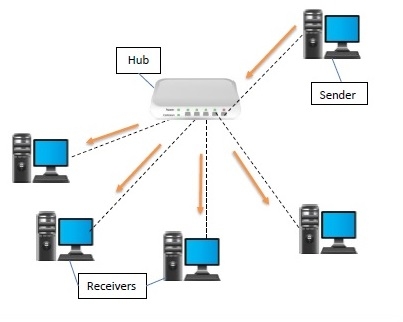
it is multi port network device that connects multiple devices to network to communicate with each other. It function is to broadcasting the data received to all connected devices. It doesnot have intelligence to filter or direct data packets to specific device which cause unnecessary traffic and network congestion.
It operates in OSI physical layer (layer 1).
It is less efficient as compared to switches and it is affordable so it is used in simple network setups.
Repeater
It is networking devices that regenerate and amplifies the weak signal to make it to travel far further with original strength. The digital signal get weakens due to attenuation so It does not travel to long distance so Repeater used there . It receives weak signal , amplifies it and retransmits with original strength.
It operates in OSI physical layer (layer 1).
Repeaters are commonly used in large buildings, extensive wired networks, or outdoor wireless setups to eliminate dead zones and maintain reliable connectivity over long distances.
Switch
It is multiport device that connects multiple devices in LAN and efficiently manage the flow of data between them. It operates at Data-Link layer of OSI model (Layer 2). It uses MAC Address to direct the data packets to intendent receipts unlike HUB who send the data to all connected devices.
It filter the data on the basis of MAC Address so there is less chance of network congestion and Switch allows administrators to configure it to manage and monitor the traffic.
Widely used in both home and business, switch plays crucial role in ensuring fast , reliable and secure connection between connected devices in network.

Routers
It connects multiple networks and directs data packets between them, ensuring efficient communication and internet access. Operating at the network layer (Layer 3) of the OSI model, a router analyzes the destination IP address of data packets and determines the best path for their delivery. It connects devices within a local area network (LAN) to external networks, such as the internet, enabling seamless data transmission.
Routers also provide additional functionalities like assigning IP addresses, managing network traffic, and offering security features such as firewalls. They can be wired or wireless, with wireless routers allowing devices to connect via Wi-Fi. Commonly used in homes, offices, and enterprises, routers play a vital role in enabling connectivity and communication across networks.

Load Balancer
Load Balancer is a networking device or software solution that distributes the incoming network traffic across multiple servers to ensure optimal performance , reliability and availability.it acts as a traffic manager, balancing workloads to prevent any single server from being overwhelmed which help maintain system responsiveness and minimize downtime.
Load Balancer operates at different layer of OSI Model ( layer 4 for transport and layer 7 for application) and use algorithm such as round robin , list of connections and IP hashing to distribute traffic.
Commonly used in data center, cloud environments, and large-scale web application .It plays vital role in system scalability, fault tolerance and overall network efficiency.

Firewall
It is networking device and software solution that acts as a security barrier between network and external traffic like Internet to prevent from unauthorized access, cyber attacks and data breaches. it operates in various layer of OSI model. it monitors and control incoming and outgoing network traffic based on predefined security rules and policies.
It examines the data packets, determines their source and destination and allows and block them according the rules . they are hardware , software of both deployed in office , home, business and data center. By filtering traffic and block harmful connection, firewall play a crucial role in maintaining network integrity, confidentiality and overall cybersecurity.

Conclusion
Networking devices are essential for building, maintaining, and managing networks. From simple devices like hubs and switches to advanced tools like routers, firewalls, and load balancers, each device has a specific role in ensuring efficient communication and security. Understanding these devices helps in designing networks that are faster, reliable, and secure.

